parentingpsy.comFor parents, to help their children
Safe Response Formula

Calm toddler tantrums
by saying less.

I give you the Safe Response Formula — so the big feeling gets released instead of pushed down, and doesn't come back louder next week.

Video lessonPDF materialInstant access
I want a calmer home

Watch tonight · Use it at tomorrow's meltdown

Samanta
“A child doesn't calm down because of your words. They calm down next to a calm adult.”
1 · The problem

4 scenes that repeat
almost every day.

If even one of them looks like your home — this is for you.

Hitting

Sunday morning. He wants one more sweet, you say no — and his hand lands on your face. At the grandparents'. Everyone goes quiet and looks at you.

It ends with you raising your voice, him screaming louder, and both of you feeling awful by bedtime.

Biting

It's the third call from daycare this week — he bit another child. At home he bites you when you're in a rush or on the phone.

It ends in embarrassment at pickup and the thought: “what am I doing wrong?”

Throwing

Bedtime. Blocks fly, doors slam, he drops to the floor and kicks. Zero to meltdown in three seconds.

It ends with you giving in just to make it stop. Tomorrow it happens again, only louder.

Screaming

The supermarket. He's screaming flat on the floor, people steer around you. You feel your chest tighten and you don't know whether to be firm or gentle.

It ends with you leaving without the groceries and crying in the car.

You're not a bad parent.
Your nervous system simply doesn't have a plan for moments like these.

2 · What doesn't work

Four things that make
the meltdown last longer.

Too many words

Mid-meltdown a child can't process long sentences.

Teaching in the middle of it

“You can't do that” teaches nothing in that second.

An unclear limit

Sometimes allowed, sometimes not — so the child keeps testing.

Your automatic reaction

When you escalate, your child escalates further.

3 · A demonstration

How it looks in
a real moment.

One scene, two reactions. Your child hits you.

The usual reaction

“How many times have I told you not to hit? Say sorry right now!”


What happens: a lot of words, rising tension, and a child who has stopped hearing them.

With the system
1
Your child feels seen
2
Your child feels safe
3
Your child learns to regulate emotions
4
The meltdowns get fewer

Four moves, under a minute, no raised voice. The exact words for each one are inside.

4 · The system

What the 4 + 3 system actually is.

One sequence for your child, one for you. Both on video; the PDF holds the situations.

4-step response system

When your child boils over

On video you'll learn:

  • how to react in the first seconds;
  • what to say when they scream, hit, bite or refuse;
  • how to hold a limit without threats or negotiating;
  • when to speak, and when words are too many;
  • how to reconnect once it's over.
3-step self-regulation system

When you boil over

On video you'll learn:

  • to catch the moment before the automatic reaction;
  • to stop the impulse to shout or threaten;
  • to steady your body while standing right there;
  • to act deliberately even when you're boiling;
  • to recover, so guilt doesn't pile up.
Inside

You watch me say it —
then say it yourself tonight.

Not another PDF to skim and forget. It's a small video course you open on your phone: I walk you through each moment, you hear the exact tone, and the words stay with you.

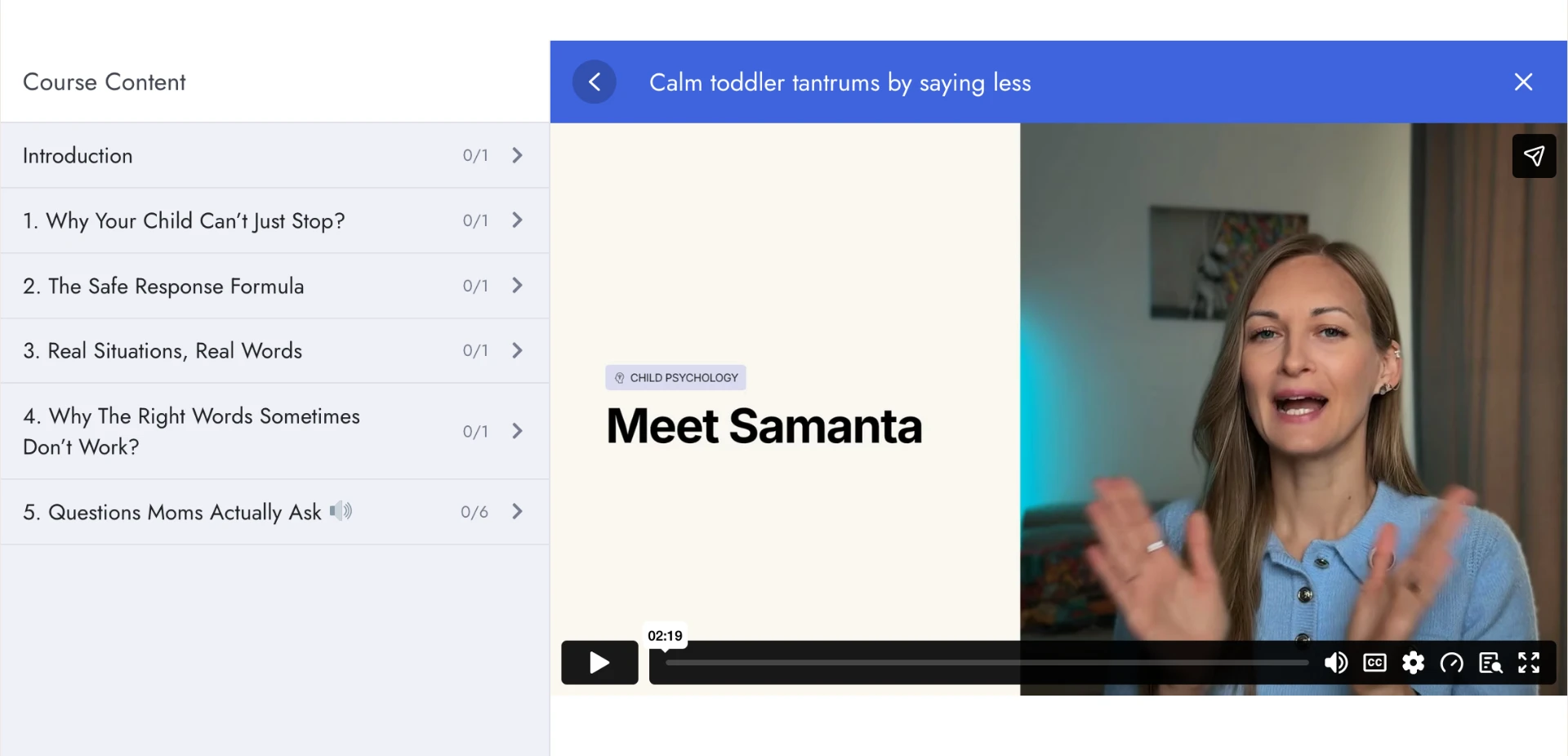
Inside the course — lessons on the left, video on the right
Why your child can't just stopWhat's happening in their brain.
The Safe Response FormulaA simple 4-step system for every meltdown.
Real situations, real words8 everyday scenes, sentence by sentence — one-page PDF.
Why the right words sometimes don't workA 3-step system for your own calm.
Questions moms actually ask6 audio answers, recorded for you.
5 · The outcome

A calmer child and a parent
who trusts themselves again.

Today
After the first evening
I react on impulse and regret it after
I know what I'll do in the first second
Meltdowns are long and happen daily
Meltdowns get shorter and rarer
I feel like a bad parent
I trust my own calls again
The house is permanently tense
The air at home is calmer, for both of us

What parents write afterwards.

Hi Samanta.

Thank you again for the guide. Really interesting. I read it and it felt good to have it confirmed that I handle my daughter's big emotions the right way (even though everyone around me firmly teaches otherwise, I'm holding my position). I found some new things to think about too.

Thank you for what you're creating 🌺

❤️

Good afternoon. So much useful info for €17 😲🤩 I really didn't expect this much 🙈🙉 I want to thank you so much and I'm off to try it out 🤗 Wishing you a lovely weekend 🌞🌸🫶

❤️
Samanta
About me

Samanta — child and parent psychology mentor.

I work with children's emotional regulation, the reasons behind behaviour, parents' own reactions, and with neurodivergent children. I built this system so that theory turns into actions a parent can actually remember mid-tantrum.

Let's begin

The next tantrum is coming.
This time you'll know what to say.

  • You finally understand what's happening in your child
  • You know the exact words for 8 everyday situations
  • You stay calm, even when they don't
  • You get my answers to the questions parents ask most
€27€17
Get instant access

One-time payment · Watch it tonight · Yours to keep

FAQ

Frequently asked questions

What exactly do I get?

Short video lessons explaining what's happening in your child and the Safe Response Formula step by step, a one-page PDF with 8 everyday situations written out sentence by sentence, a lesson on keeping your own calm, and audio answers to the questions parents ask me most.

How long does it take?

Under an hour in total, and you can start tonight. Most parents notice shorter meltdowns within the first one to two weeks.

What ages is this for?

Mostly toddlers and children aged 1.5–8. The formula works with older kids too — only the wording changes.

What if I'm the one who explodes?

Then start with the lesson on your own calm. It's a three-step system for you, not your child. And no, one bad evening doesn't undo everything. Repair counts more than perfection.

I've tried gentle parenting and it didn't work.

Most of it fails because it tells you to be calm without telling you what to actually say. Here you get the exact sentences, for the exact situations, plus what to do with yourself first.